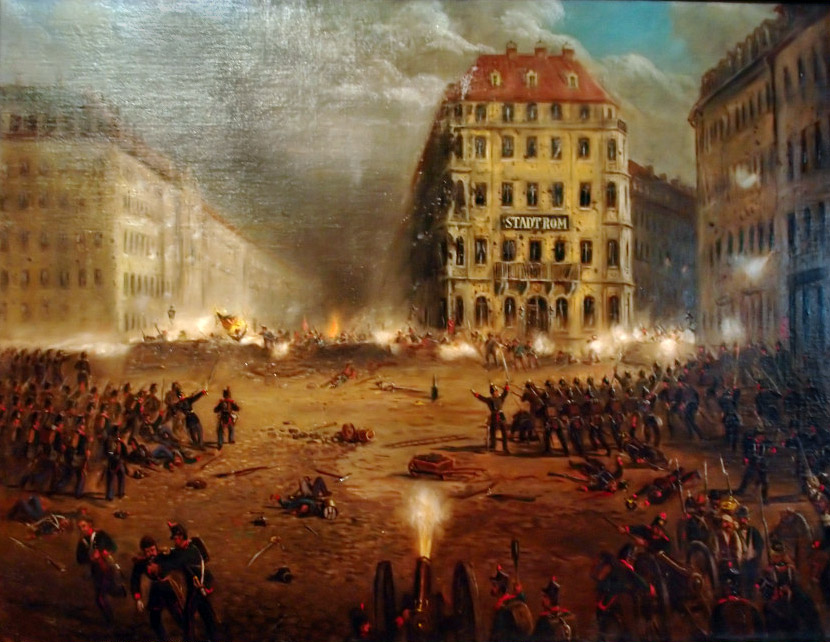
“How men have to fight for a little freedom! When will the time come when all men will have equal justice?”
– Clara’s diary, Dresden 1849
The Dresden Revolution
There’s a weird myth that Clara Schumann was a staunch apolitical conservative. Which is easily disproved by her diary entries detailing the Dresden Revolution. Not only was she living in Dresden during the revolution, she rescued her children during the battle while seven months pregnant.
Her diary’s detailed accounts of the events from May 3rd to 11th in 1849 are striking and horrific.
Content Warning: Violence, death, descriptions of war and terrorizing of civilians.
May 3rd: Violence breaks out
The violence broke out in Dresden “like a lightning flash in a clear sky” reads the Litzmann bio. Clara and Robert went on a dinner outing to a restaurant villa, and shortly after they returned home, Clara writes:
“Drums sounded a general alarm, bells rang from every tower, and soon we heard firing. The King had refused the imperial constitution, and they had taken out the poles of his carriage so he couldn’t flee.”
May 4th: Tensions rise
Clara and Robert walked into the city center to find utter lawlessness. Men with scythes stood guard while barricades were built with dug up street cobbles. The King had fled during the night, but soldiers were encamped with cannons near the castle.
They saw 14 bodies on display in the hospital courtyard as a spectacle. There was no fighting for 24 hrs but Clara writers,
“The tension was dreadful; how would it all end? In what spilling of blood!”
May 5th: Robert escapes with his life
“A terrible morning!” Clara writes. Rebels knocked on their door wanting Robert to join the revolutionaries in their fight. After Clara refused them twice, they threatened to search the house for him. So Robert and Clara escaped.
Clara doesn’t say why Robert couldn’t fight. Some assume it was because he didn’t believe in the cause or was cowardly. More likely it was Robert’s precarious health. His chronic “nervous condition” would’ve made a violent battle impossible to endure. Also, Robert, the sensitive poet, was never a fighting man.
I’m honestly not sure if he knew how to fire a gun. It’s a good thing they ran. He likely would’ve died in the fighting.
But they fled so quickly to save Robert, they left their children behind with the nanny. Clara writes:
“I was very distressed, but there’d been no time to take the children with us. Besides Robert thought we should be back by evening, though I did not believe it, especially as shortly before we left, they began to storm the city and fight.”
Clara, seven months pregnant with her son Ferdinand, took the train out of town with Robert. They walked to the estate of a friend, an old military general and his family living in the small town of Maxen.
“My anxiety all day was frightful, for continually we heard the thunder of the cannon, and my children were in the city. In the evening, I wanted to go into the city to fetch them, but I found no one would accompany me.”
Neither Robert, nor any man, would go into the city with her, not even for the children, for fear of their own lives. Insurgents were conscripting all men capable of fighting into the battle against the king’s soldiers. But eventually Clara found another woman brave enough to go with her.
Only later in July does her diary say her third son was born. We have to count backward to know she was in her third trimester when this was happening!
May 7th: Clara rescues her children
“I went to the city at 3 in the morning, accompanied by the daughter of the estate manager. It was a terrible [carriage] drive. I was anxious lest I should never come out of the city again! I did not think that I should return that self-same way, today…
We walked across a field… We entered [the city] amidst the continuous thunder of the cannon, and suddenly we saw 40 men with scythes coming toward us. At first, we did not know what to do, but we plucked up heart and went quietly through.”
They walked for miles. When they finally reached Clara’s home, she found all the houses on the street shut.
“It was horrible! Dead silence here; in the city incessant firing. I found the children still asleep, tore them at once from their beds, and had them dressed, put together a few necessaries, and in an hour, we were once more together in the field outside the city… Before dinner we were back in Maxen.”
Robert was beside himself, of course. Clara doesn’t say his opinion on her rescue adventure. (It’s possible, since she left in the middle of the night, she left while he slept.)
“My poor Robert had been spending anxious hours, and was therefore doubly happy now.”
The Revolutionary Battle:
That day, she writes of great respect for the revolutionaries, and clearly hoped they would win:
“The people are behaving splendidly, I should never have expected such courage of the Saxons. Reinforcements pour into the town incessantly… But the soldiers also continually receive fresh contingents from Prussia which exasperates the people to the highest pitch.”
The fighting continued on May 8 – 9. The friend’s estate where they stayed had some aristocrats in residence. Clara writes of discord:
“All these aristocrats spoke of the people merely as canaille and rabble, till it made one quite uncomfortable—our host is the only liberal minded person and tells them roundly what he thinks!”
The fighting came to an end when fires broke out across the city, destroying whole blocks of buildings including the opera house. The soldiers threatened to bombard the chief barricade, so the provisional government and many revolutionaries, including Richard Wagner, were forced to flee the city.
Aftermath of Death and Destruction
On May 10th, Clara describes frightening violence committed by the Prussian soldiers:
“They shot down every insurgent they found. An inn keeper had to look on while soldiers shot a room full of 26 students one after the other. They are said to have thrown dozens of people from 3rd and 4th story windows.”
Here Clara writes her cry of outrage:
How men have to fight for a little freedom! When will the time come when all men will have equal justice? How is it possible that the belief can so long have been so deeply rooted among the nobles that they are a different species from the bourgeois!”
On May 11th, Clara and Robert visited the city and walked the battle grounds:
“One sees thousands of bullets in the houses, whole pieces of wall are broken away, the old opera house has been destroyed by fire… It is terrible to see… Walls of houses were broken through to enable the insurgents to correspond with each other through several houses. How many innocent victims there have been, killed in their own rooms by bullet holes. The Frauenkirche is full of near 500 prisoners.”
The streets were torn up. Martial law reigned. Thankfully their friends allowed them to stay outside the city with them for weeks. Clara’s father visited and – in evidence that denial is part of human nature – Friedrich Wieck didn’t believe any of the atrocities they’d seen.
Even after they returned home in June, the Prussian soldiers still occupied the city and they were obligated to feed them. Clara complained that food was scarce for months.
The Exile of Richard Wagner
Richard played an important role in the Dresden revolution. Clara writes:
“Kapellmeister Wagner is said to have played a part among the republicans, to have made speeches from the town hall, to have caused barricades to be built after a system of his own, and many other things!”
By “other things,” Clara means he was also in the tower of the Frauenkirche, posted as lookout for the invading Prussians. The famous soprano, Wilhelmine Schröder-Devrient, Richard’s favorite singer and Clara’s friend, was also at the barricades and imprisoned for a short time afterwards. #badassdiva
Clara Schumann really was admiring and full of respect for Richard’s heroic acts. (They weren’t enemies yet!) A few days later, “bills were issued for Wagner’s apprehension.” There was a legit “WANTED” poster out for Richard’s arrest. He’d be forced into exile in Switzerland. Clara wouldn’t see him again for another ten years, not until after Robert died.
Musical reaction
The week of the revolution Robert started composing all sorts of German patriotic choral works, songs, and marches inspired by the revolution. Clara was a little busy taking care of her transplanted family during those weeks, oh and then giving birth to her sixth child. But later she wrote choral works and her opus 23 Jucunde Songs to the poetry of political poet Hermann Rollett. The poetry is packed with patriotic symbolism for a united and free Germany.
Clara Schumann was a liberal supporter of revolution who expressed those beliefs in her compositions and in her concert programming.
 The Clara Schumann Channel