“There is nothing greater than the joy of composing something oneself and then listening to it.”
Clara Schumann’s diary, 1846
The most frequent question I get in my social media DMs comes from women who are confused by the quote, “A woman must not desire to compose,” written by Clara Wieck in 1839.
It is among her most famous one-liners. Without the crucial context, it implies Clara Schumann thought women shouldn’t compose. It’s mislead many to believe that the reason Clara stopped composing was because she didn’t think she should.
Which is absolutely false.
At age 20 when Clara wrote that sad quote, she had only published 11 of her 23 opuses. She did not stop composing. She was only half done. But it’s a very difficult quote to make sense of. Why would one of the greatest, most respected musicians and composers of the 19th century write such a thing? The short answer is: insecurity.
Every creator has moments where they look at their work and think some version of, “This is trash. I suck. Why do I bother? I should quit.”
For women during the 19th century, they dealt with so much messaging and heard so often in society that it was wrong for them to compose, their insecurity would often inhabit this gender prejudice. That quote of Clara’s should have quotes AROUND IT. She was parroting what she’d been taught, but the point is:
She kept on writing music anyway.
(A version of this article was first published on the Donne Foundation blog in 2021. Please check out their website and all the amazing work they’re doing for women composers.)
Clara Schumann’s Imposter Syndrome
The full context of the quote also completely changes its meaning. Clara was basically having a the kind of moment in which we all can relate. If Clara had had social media, her post for the day would’ve been like, “I quit. I can’t do this anymore. Why should I bother? Everyone thinks I suck.”
In other words, she didn’t actually quit. She was just having a bad day. Even Clara had days where she hated herself, wallowed in depression, and battled imposter syndrome.
She was young when she wrote it – only 20 years old – but she had just published her 11th opus! This was after her piano concerto opus 7. (For more context, it’s the same age of 20 as when Robert and Johannes were publishing their FIRST opuses.)
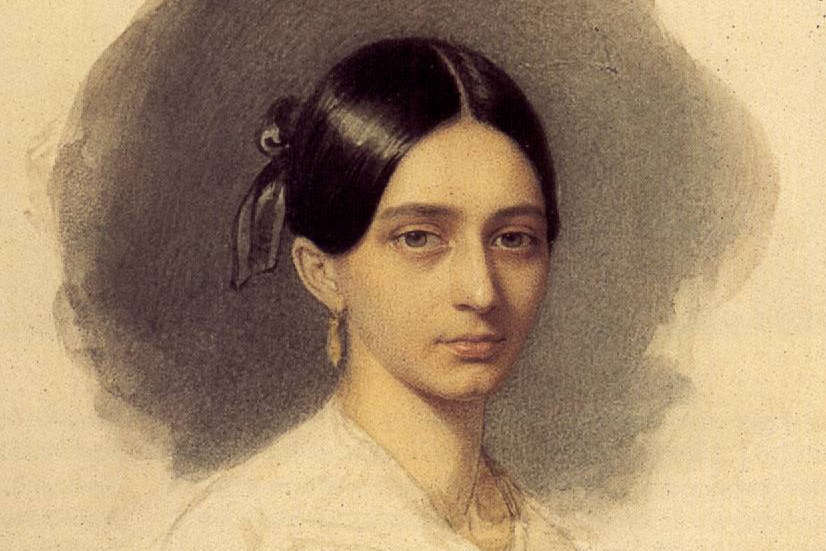
Below is young Clara Wieck 1840, at age 20, the year she wrote the infamous quote, 16 years before she quit composing in 1856.

Also Clara’s motivation for writing such a harsh statement turns its meaning upside down: She wrote it in response to inadequacy after hearing about ANOTHER WOMAN COMPOSER. (Talk about a moment where she wasn’t really thinking straight…phew!)

Marie Pleyel (1811-1875)
In 1840, Marie Pleyel, a pianist rival of Clara’s, was having a triumphant tour across the continent. When Marie performed in Leipzig, Clara’s father began duplicitously supporting Marie the way he used to support his daughter. (Yes, Friedrich Wieck did some really awful sh*t in protest of Clara’s engagement to Robert.)
Clara was understandably devastated that her father chose to support another woman above his own daughter. She wrote in her diary:
‘Everything that I read about [Marie Pleyel] is an ever clearer proof that she is above me; and if this be so I can hardly fail to be completely downcast. I think that I shall submit to it in time, for indeed oblivion is the fate of every artist who is not creative. I once thought that I possessed creative talent, but I have given up this idea; a woman must not desire to compose—not one has been able to do it, and why should I expect to? It would be arrogance, though indeed, my Father led me into it in earlier days.’”
Clara Schumann’s diary, 1839. (Taken from the Berthold Litzmann biography of Clara Schumann published in 1902, translation by Grace E. Hadow)
Irony of ironies, Clara wrote the quote in response to a rivalry with another woman composer, Marie Pleyel.
Clara’s father was on a rampage to sabotage his daughter’s career in retaliation for her refusing to end the engagement to Robert. It was all very tragic and embarrassing. He withdrew his support for Clara and publicly told everyone that Marie Pleyel was better than his own daughter. This had a devastating effect on twenty-year-old Clara’s confidence, though Clara never heard Marie play. The two women never even met.
The diary entry is full of contradictions, a private painful confession not written out of sense or logic. Clara was upset and confused by the betrayal of the man who’d been her parent, teacher, and career champion.
She contradicts herself multiple time within the same diary entry: claiming Marie was “proof she is above me” then undermines all women composers. Clara neglects to note, or is unaware of the fact, that Marie was eight years older than her. These inconsistencies show Clara’s vulnerable age of twenty. Though she’d already achieved an international renown as a formidable piano virtuosa, as a composer she was struggling for confidence.
Other similarly contradictory statements appear in her letters around this time. Writing to her fiancée almost two years before the diary entry:
“I always console myself by thinking that I am a woman, and they weren’t born to compose. I often doubt myself. But I remember that you did not want to speak of doubts anymore; I agree with you! Doubt is a disastrous word and also a disastrous state to be in.”
Clara Wieck to Robert Schumann, March 4th 1838
She realizes, even as she’s writing it, that to judge herself based on gender is a statement of self-doubt — or what today is termed imposter syndrome. Her recognition of these thoughts as self-doubt hints that she knew it wasn’t true.
Clara Schumann Loved Composing
Her desire to write music, no matter her turmoil, was irrepressible. Clara composed for another fifteen years after these writings. Her opuses 12 through 23 included some of her best works—her piano sonata, piano trio, dozens of lieder, piano romanzes, violin romanzes, a first movement of a second piano concerto, and more.
She supported other women composers, helping Josephine Lang publish songs, performing Fanny Hensel, and loving the operas of Pauline Viardot. Though society told her she should “not desire to compose,” she never could suppress it or condemn other women for it. Her desire overpowered her self-doubt, thankfully.
Clara’s passion for composition shines through in her diary on October 2nd, 1846. At age twenty-seven (already a mother of four), her confidence was growing. After hearing her new Piano Trio in G-minor played for the first time, she writes:
“There is nothing greater than the joy of composing something oneself, and then listening to it.”
Clara Schumann’s diary, October 2nd, 1846, age twenty-seven
Amidst her extraordinary career, full of laurels and unparalleled success, her statement implies her love of writing and hearing her own music soared above her joy in performing.
Why did Clara Schumann stop composing at age 37?
She doesn’t say, but there are many possibilities.
The timing, 1856, intersects with the death of her husband. It’s possible her grief played a role in the end of her creations. French composer, Louise Farrenc also stopped composing when her daughter died. Writing music as gifts for her husband had motivated almost half of Clara’s works during marriage. Without him, perhaps it simply hurt too much.
Composition also requires leisure time. American composer, Florence Price wrote that a painful injury became a boon for her creations, “When shall I ever be so fortunate again as to break a foot.” It enabled her the time to write some of her greatest orchestral works.

Clara Schumann, age 34 in 1853
At age 37, Clara’s leisure time all but disappeared when she became a single parent. Under the strain of the perpetual concert tours necessary to support her seven children and her husband’s hospital care, the luxury to compose fell on the sacrificial pile.
There’s also the factor of reviews and public prejudice against women. Critics were brutal of most women composers and misogyny in Germany got worse and worse in the mid to late 19th century. (I’m still researching this, but Clara’s decisions were definitely influenced by the society around her.)
In other words, Clara quit composing for many reasons, but because “a woman should not desire to compose” was not one of them.
Misogyny Against Women Composers
Publications attesting to how women should not or could not compose were numerous in the 19th century. Here’s one a pamphlet circulated in 1873 by Otto Gumprecht titled “Women in Music”:
“Explains the lack of women in music as a natural outgrowth of women’s supposedly essential inability to handle challenging intellectual tasks such as music composition.”
As quoted in Brahms in the Priesthood of Art by Laurie MacManus
That this harmful rhetoric made its way into Clara’s diary is no surprise. In fact, Clara’s confession is irrefutable proof of how these messages affected women composers, of the internal struggles they faced because of the external messages. Thanks to Clara’s diary no one can try to say that women weren’t bothered by what people said about them.
Perhaps Clara’s belief on the subject of women composers should be summed up as confusion—confusion that society preached she should not be capable of what she innately desired.
My plea for the future: When we speak of Clara Schumann the composer, may the line we quote of hers not be one of self-doubt but one of irrepressible desire:

